
Research Catalogue of Ninety Approaches
This catalogue records the actual scope of ninety numbered approaches developed in an AI-assisted investigation motivated by sound. The common question concerns
where the frequencies are distinct positive integers, every amplitude is one, and all phases arise from the same variable. The desired conclusion is one absolute positive constant such that for every admissible set. This collection neither proves that conclusion nor supplies a counterexample to it.
The numbers identify research branches, not independent discoveries. Several branches revisit the same mechanism in a different language: frequency compression reappears as a finite-cutoff function; Gibbs weighting reappears as imaginary-time evolution; rational factorization reappears as amplitude quantization. Those connections are part of the record. A failed proposed inequality is an informative negative result only within its stated scope.
Evidence labels and reading conventions
- Proved in the notes: a mathematical argument is supplied in the linked record. This label does not mean external peer review, formal proof-assistant verification, or established novelty.
- Exact counterexample: an explicit construction disproves the specified intermediate assertion. It does not automatically disprove the original conjecture.
- Finite computation: the conclusion applies to the reported finite search or certificate. Approximate reconnaissance and exact certification are distinguished.
- Conditional or unresolved: a useful reduction has been made, but its sufficient hypothesis has not been established.
- Reconstructed or historical: the original working files were lost. A replacement text or an earlier report survives; these are not interchangeable with the missing bytes.
The catalogue is written in English. Linked historical records retain their original English or Russian wording so that corrections and provenance remain inspectable. The accompanying verification report identifies what was rerun for this publication; references to older executions below are historical evidence, not a claim that every experiment has just been repeated.
Unnumbered groundwork: retained without retrospective numbering
Before the numbered series, the project explored exact finite searches, simulated annealing, Bernstein positivity certificates, spectral Gram matrices, damped products, scalar moments, and a probability-convolution reformulation. These materials are included as groundwork rather than being relabelled as additional approaches. Their main role is to establish the target, expose tempting relaxations, and supply reproducible small examples.
The finite-search directories include searches in bounded frequency universes, logs, and certificates. Such searches can certify statements inside their specified universes; none bounds the unrestricted maximum frequency. The general-method notes separately investigate whether the resulting patterns could support an all-frequency theorem. A probability density with a flat nonzero Fourier spectrum gives a reversible reformulation, while a singular measure shows why absolute continuity matters. A damped-product monotonicity claim is refuted by an exact integer calculation. The moment and spectral records contain additional countermodels to restricted proposed estimates.
Sources: general checkpoint, original report, finite computation guide, finite-search audit, moment obstructions, and factorization notes.
A selected fresh reproduction during publication preparation rechecked the exact finite optimum over all 4,194,303 nonempty subsets of . Two different enumeration methods identified the same unique minimizer of :
Its depth is strictly between and , certified by exact polynomial arguments. The finite comparison does not extend beyond the specified universe. Details and current execution evidence are in the groundwork reproduction report.
Approaches 01–20: unconventional mechanisms
01. Replace commuting rotations by free rotations
Outcome: exact transfer refuted; weaker comparison unresolved. The idea replaces the commuting shifts behind a cosine sum with noncommuting shifts, whose spectral edge is explicitly accessible. The proposed transfer of that edge back to the original one-dimensional model fails already for , where . A group quotient can compare the relevant positive edge without giving the required comparison of negative edges. The calculation therefore identifies a missing directional inequality, rather than invalidating spectral methods generally. A weaker comparison with an absolute loss remains a separate, unproved candidate.
Source: physics record.
02. Use fermionic determinants and exterior powers
Outcome: two specified shortcuts refuted. Positive Toeplitz matrices can be studied through determinants and exterior powers, suggesting a fermionic description of simultaneous constraints. The record checks the full matrices rather than assuming that a short Fourier support creates a short matrix rank. That rank-collapse premise is false. A further proposed inequality subtracting a variance contribution from a determinant quantity also fails on an explicit example. Positivity of all finite sections remains valid and useful, but it does not supply the missing term-count estimate without another argument linking those determinants to the negative spectral edge.
Source: physics record.
03. Locate complex-temperature partition-function zeros
Outcome: proposed zero-location premise refuted. The partition function packages the full wave into a single analytic function. An analogy with Lee–Yang theory suggested that a rigid location of its complex zeros might force a large negative edge. For , the exact third moment contradicts the symmetry required by the proposed universal imaginary-axis zero argument. The physical theorem’s hypotheses cannot simply be imported into this cosine model. Partition functions remain a valid representation; later Gibbs branches pursue their real-temperature properties without the false zero-location premise.
Source: physics record.
04. Evolve the whole wave by heat flow
Outcome: evolution identities proved; proposed ratio control refuted. Heat evolution damps the mode by , allowing exact energy and minimum comparisons while treating the original sum as one function. However, this flow immediately replaces equal amplitudes with unequal amplitudes. An infinite evolved family defeats the proposed control relating its remaining energy to its negative minimum. The obstruction is to that particular quantitative transfer, not to heat analysis itself. Branch 85 revisits the same mechanism as phase jitter and supplies an explicit error budget that depends on the frequencies.
Source: physics record.
05. Stop a Brownian representation of the analytic polynomial
Outcome: scalar-data shortcut refuted. Evaluating the analytic polynomial along stopped Brownian motion gives a martingale representation and a quadratic-variation identity. The hope was that stopping-time information would force a negative excursion of order . An explicit stopped-process countermodel shares the proposed scalar constraints while violating the desired conclusion. Analyticity alone also fails to repair the tested inference. A successful refinement would have to retain additional information about the equal integer Fourier coefficients; mean, variance, and quadratic variation do not independently encode that structure.
Source: physics record.
06. Bias rational sampling with Gauss sums
Outcome: arithmetic partial bound proved; bounded-grid coverage refuted. Quadratic characters produce nonnegative sampling weights on roots of unity and an exact relation between residue information and a negative witness. This gives a valid arithmetic certificate when the frequency residues cooperate. Any predetermined finite collection of such grids, including grids combined through the Chinese remainder theorem, can nevertheless be defeated by an admissible family of frequencies. The missing step is a uniform choice of useful modulus. Failure of bounded preselected grids does not establish that adaptive rational sampling or all arithmetic certificates must fail.
Source: arithmetic record.
07. Force growth through Mahler measure and resultants
Outcome: sufficient lemma isolated but unproved. After an integer upward shift, the cosine polynomial has integer Laurent coefficients and is nonnegative on the unit circle. Its Mahler measure and resultants offer arithmetic quantities that cannot vary arbitrarily. The notes formulate a lower bound strong enough to imply the target. Generic appeals to integrality do not establish it: the inspected reciprocal and cyclotomic examples show precisely where norms or resultants can be small or vanish. A result specific to the equal-coefficient spectrum would be needed. No new Mahler-measure theorem is claimed.
Source: arithmetic record.
08. Compress an entire frequency vector
Outcome: fixed-size attainment and effective approximation proved in the notes. The minimum is encoded by a circle subgroup of a torus. Compactness and the lattice of integer relations yield attainment of the extremal value for each fixed . A separate quantitative argument preserves sufficiently many relations to replace any set by bounded frequencies while changing by at most a prescribed error. The displayed bound is very large and depends on and the error, but not on the original maximum frequency. This supplies an approximation procedure; it does not prove a lower bound uniform in .
Sources: arithmetic record and separate audit.
09. Detune frequencies irrationally and take a limit
Outcome: interchange of limits refuted exactly. Infinitesimal irrational detuning can make phases explore a larger torus and permits near-simultaneous negative alignment. For , the original depth is ; for with irrational , the unrestricted-time infimum has depth two. Returning the detuning to zero therefore does not recover the original full-time infimum. On any fixed observation interval the signals do converge. The obstruction is the order of the time and detuning limits, not continuity of cosine or the correctness of torus equidistribution.
Source: arithmetic record.
10. Read the complex image curve through area and winding
Outcome: identities valid; direct geometric inference refuted. The polynomial traces a complex curve whose signed area has an exact Fourier formula. Poisson extension also controls its values inside the unit disk. These are legitimate whole-function transformations, but signed area carries frequency weights that cannot be replaced automatically by the number of frequencies. Large exterior values similarly need not provide the desired boundary minimum. The tested transfers fail on explicit examples. Additional coefficient-sensitive geometry might still be useful; the recorded calculations do not eliminate that broader possibility.
Source: arithmetic record.
11. Round a positive Fejér taper with bounded prefix errors
Outcome: finite obstruction certified; asymptotic behavior unresolved. A prefix-floor rule converts a nonnegative weighted profile into an admissible zero-or-one frequency mask. Its cumulative rounding error is bounded, suggesting that positivity might survive approximately. Eight targeted sizes were checked. At , an exact rational negative witness proves for the specified constructed set. This is a certified value at one point, not its global minimum. Neither that finite check nor the prefix-error identity rules out every possible asymptotic improvement or every other rounding rule.
Sources: construction record and stored checks.
12. Reverse the signal by a nonlinear change of time
Outcome: exact reversal and a uniform small-error variant refuted. The proposal seeks one transformation of the common time that maps the whole wave approximately to its negative. Such a transformation would transfer the obvious positive peak into a negative peak without independently altering the modes. Exact examples show that the necessary symmetry is absent. The notes also rule out the tested universal reversal with sublinear uniform error. Choosing a separate phase for every frequency would solve a different feasibility problem. Special parity-symmetric sets do possess exact reversal; branch 80 classifies their maximal-depth case.
Source: construction record.
13. Randomize whole sets and exchange the order of play
Outcome: relaxation too weak; domain correction preserved. Mixing entire frequency sets appears to invite a minimax proof. In the unrestricted frequency universe, the examined relaxed game has value , so it cannot prove any lower bound growing with . A later clarification distinguishes that universe from a fixed finite cutoff, where the exact value is different and explicitly calculated. This correction matters: an infinite-domain construction cannot be asserted for every bounded domain. The failed relaxation would require a rounding theorem preserving a negative witness, and no such theorem was obtained.
Sources: construction record and corrected game-domain statement.
14. Translate negative peaks into spin frustration and cuts
Outcome: valid transfer with an unresolved equivalent-scale requirement. A frequency distance graph supports a spin or cut interpretation. Properly constructed whole-graph cuts do yield witnesses for the original cosine problem. Independent-phase and magnetic-gauge shortcuts, however, do not preserve the one-parameter model and are explicitly rejected. The cut surplus sufficient for a square-root bound turns out to have essentially the same quantitative difficulty as the original target. This is a useful reformulation, not an independent proof. Later finite-graph and lattice-operator branches distinguish which graph compressions preserve enough information.
Source: construction record.
15. Clip negative values and restore the desired spectrum
Outcome: positivity shortcut refuted; iteration characterized. Clipping a wave makes it nonnegative, but projecting the clipped function back onto its original Fourier support can recreate negative values. An exact example demonstrates that failure. A natural alternating rule that adapts the constant term instead does converge to the unknown threshold . Its correctness as a recovery procedure is therefore compatible with its failure to prove any growth rate. A square-root theorem would need an additional bound on the total accumulated correction; convergence alone supplies no such quantitative estimate.
Source: construction record.
16. Seek a contradiction from a vanishing weak limit
Outcome: automatic energy contradiction refuted. A hypothetical sequence with unusually shallow negative peaks might converge weakly to a simple limit after normalization. The tempting inference is that its energy must then disappear, contradicting orthogonality. A concentrated weighted countermodel shows why this is invalid: weak convergence need not preserve squared norms or prevent energy from concentrating on shrinking sets. The model is a test of the proposed compactness inference, not a set of unit-amplitude frequencies disproving Chowla. A successful limit argument would require an additional quantitative compactness or uniform-integrability property.
Source: information record.
17. Bound the information content of the shifted wave
Outcome: Shannon shortcut refuted; Rényi target equivalent to the problem. The normalized nonnegative function is a probability density with an exact second moment. Its order-two Rényi entropy therefore encodes . A uniform bound of the required kind would indeed settle the target, but it is not independently established. The weaker suggestion that ordinary Shannon entropy controls that second moment fails because rare tall spikes can behave differently under the two functionals. This distinction motivates the later entropy-budget branch, where the exact variational problem and its scope are stated explicitly.
Source: information record.
18. Prevent hidden peaks with a sparse uncertainty inequality
Outcome: a valid but quantitatively insufficient bound. A Turán–Nazarov inequality controls an exponential polynomial on an interval from its values on a measurable subset. Applying it to the set where the negative contribution is limited yields a lower bound for independent of the largest frequency. Its dependence on the number of terms is exponentially weak, however, and does not approach the desired square-root scale. The calculation is a legitimate application of an existing theorem. It rules out neither stronger uncertainty estimates for this special coefficient pattern nor other ways to exploit the same inequality.
Source: information record.
19. Replace trigonometry by an algebraic square certificate
Outcome: per-set certification valid; premature degree bound false. Substituting gives , so positivity can be certified on using standard polynomial sum-of-squares representations. This provides an exact method for a prescribed set. The polynomial degree is nevertheless tied to the largest frequency, even when the number of terms is small. A certificate-degree bound based on term count alone does not follow before compression. Branches 08 and 56 address approximate frequency compression, while branch 83 uses polynomials in the value of the wave instead.
Source: information record.
20. Use a passive-filter logarithmic balance law
Outcome: logarithmic identity valid; proposed shortcut refuted. Shifting the analytic polynomial into the positive-real half-plane creates a zero-free function and a mean-log identity reminiscent of a passive filter’s balance law. The examined inference from this average logarithmic information to a sufficiently large negative excursion fails on an explicit zero-free family. Its true negative excursions can be linear while the proposed criterion does not capture them. This separates a correct analytic identity from an unsupported quantitative conclusion. It does not assert that passive-system methods, causal factorizations, or all logarithmic estimates are intrinsically unsuitable.
Source: information record.
Approaches 21–30: positivity, arithmetic, and discrete constructions
21. Divide the critical probability density into identical steps
Outcome: a general obstruction proved. The critical density is nonnegative and touches zero. If it were an integer convolution power of a probability measure, its finite Fourier support would force the root to have a nonnegative trigonometric-polynomial density. Convolving such a nonzero density with itself is strictly positive everywhere, contradicting the zero of . Thus no identical probability root of order at least two exists. With an extra positive shift, the possible root order is still bounded by the largest Fourier coefficient. This structural fact alone has no growing dependence on .
Source: analysis record.
22. Turn the shifted wave into a transport map
Outcome: exact reformulation; proposed continuity principle refuted. Integrating gives a monotone degree-one map of the circle. Its derivative energy is exactly , so controlling that energy uniformly would prove the conjecture. Small displacement of the map does not supply this control: the primitive sets with odd approach the identity uniformly while their derivative energy stays fixed. Even a one-frequency example has a non-Lipschitz inverse at a critical point. Transport geometry therefore preserves the question but does not answer it through these qualitative properties.
Source: analysis record.
23. Use only boundary contact points
Outcome: contact inequalities proved; required mass bound refuted. A Schur transform of the analytic polynomial produces exact angular derivatives and positive boundary Pick matrices at minimum points. These yield legitimate restrictions on contact data. The hoped-for lower bound for total contact mass in terms of fails for , with odd : there is one contact, its mass is , and stays fixed. The correction that a nonnegative zero has order at least two, not necessarily exactly two, is preserved. More coefficient information would be needed.
Sources: analysis record and audit.
24. Build a positive quadrature with one heavy atom
Outcome: transfer proved; uniform heavy-atom mechanism refuted. A positive quadrature annihilating the prescribed frequencies can turn a heavy atom into a lower bound on the negative excursion elsewhere. The difficulty is constructing that atom. For consecutive frequencies, a nonnegative squared polynomial forces every atom’s weight to be at most , and therefore requires at least nodes. This defeats the tested universal square-root node count or heavy-atom claim. The obstruction is fully compatible with the existence of positive quadratures and does not rule out different sampling functionals with additional structure.
Source: geometry record.
25. Use every Galois conjugate at once
Outcome: trace identities proved; generic norm argument insufficient. Evaluating a strictly positive integer Laurent polynomial at a suitable root of unity gives positive algebraic-integer conjugates. Their sum, squared sum, and product have exact formulas. The product is a positive integer, but that fact does not control their relative variance. A cyclotomic unit family has norm exactly one while its second-moment-to-mean-square ratio diverges. Its coefficients are weighted, so it refutes a broader arithmetic shortcut rather than Chowla. Any successful strengthening must use the original flat nonzero Fourier coefficients essentially.
Source: geometry record.
26. Quantize coefficients of spectral factors
Outcome: conditional counting bound and an exact obstruction proved. Suppose is a sum of squared moduli with coefficients in . Counting coefficient energy gives the correctly normalized inequality . A uniformly bounded suitable denominator would yield the target. For at , exact positivity certificates coexist with an energy obstruction to denominator one. Rational decompositions still exist with some denominator for every strictly positive rational polynomial. The missing assertion is uniform denominator control, not existence of ordinary spectral factors.
Source: geometry record.
27. Remove signs from complementary codes
Outcome: the specified admissible family fails asymptotically. Complementary signed polynomials have a striking exact cancellation of squared moduli. The construction converts their signs into positive frequency masks in the hope of inheriting that cancellation with unit amplitudes. A continuous negative witness shows instead that the resulting family has tending to infinity. An exact finite certificate also establishes at . The asymptotic conclusion comes from a separate proof, not extrapolation of the computation. The result concerns the explicit sign-removal mechanism, not every use of complementary codes.
Sources: construction record and stored checks.
28. Cancel increasingly many frequency moments
Outcome: the specified Prouhet construction fails asymptotically. A Thue–Morse or Prouhet identity balances signed power sums through increasingly high orders. Removing the signs to form admissible frequency sets exposes an uncancelled dense background. An explicit phase then produces a negative excursion large enough that diverges along the constructed family. At , a rational certificate gives . This illustrates why matching many frequency moments near one phase is not control of the complete cosine function. Other constructions with different density or geometry are not excluded.
Sources: construction record and stored checks.
29. Flatten positive Fourier multiplicities by fractional powers
Outcome: positivity preservation refuted for the tested exponent range. An autocorrelation polynomial is nonnegative but generally has repeated difference multiplicities. The proposal raises each positive coefficient to a fractional power, hoping to move continuously toward a flat support with equal coefficients. The record gives an explicit family for which the transformed polynomial has a negative value for every exponent . Thus coefficientwise flattening does not preserve nonnegativity in this setting. This is an obstruction to the proposed operation; it neither contradicts spectral factorization nor proves that every alternative way to remove multiplicities must fail.
Source: construction record.
30. Forbid infinite strict descent at a fixed number of frequencies
Outcome: structural compactness result in the notes; no algorithmic stopping certificate. Extending branch 08, the record studies the set of attainable depths for a fixed . Its subgroup-limit argument rules out an infinite strictly decreasing sequence of these values, hence gives a well-ordering property. It does not make the set of values finite; an explicit family distinguishes those assertions. Nor does it give an effective bound on the number of descent steps or a test that a current set is globally optimal. Most importantly, the statement is fixed-size and supplies no positive lower bound uniform over all .
Sources: descent record and audit.
Approaches 31–40: quantitative certificates and controlled transformations
31. Solve coefficient equations modulo integers
Outcome: unrestricted congruences too weak; an energy-capped version exact. Reducing a sum-of-squares identity modulo an integer seems to permit local arithmetic tests before constructing a rational factorization. Without a coefficient-energy cap, the examined congruences can always be satisfied and provide no useful obstruction. With total energy , a modulus larger than makes coefficient congruence imply exact equality. That is a valid finite arithmetic reduction, but enforcing the energy constraint retains the central difficulty. Passing modular equations alone should therefore never be reported as a rational positivity certificate.
Source: denominator record.
32. Construct a denominator independent of maximum frequency
Outcome: an explicit sufficient bound proved in the notes. With an additional positive shift, a binomial approximation to a square root is controlled in the Fourier coefficient norm. The number of frequencies in a power is bounded by the number of original modes and the power, not by their largest index. Rational coefficients and a diagonally dominant remainder then yield a finite sum of squares with a denominator depending on and the positivity margin. The resulting bound is enormous. It proves existence constructively but does not give the absolute denominator needed for a square-root lower bound.
Sources: denominator record, audit, and power-norm audit.
33. Make a prescribed denominator a finite decision problem
Outcome: an existence bound for a finite search proved; full search not executed. If a decomposition exists at a specified denominator, its integral coefficient energy is fixed. The notes compress coefficient-position relations while keeping the original frequencies as anchors, producing an explicit finite degree bound for at least one representation. Hence denominator admissibility can in principle be decided by finite enumeration. The bound does not constrain every possible representation, since gratuitously shifted factors can have arbitrarily large degree. The full enumerative algorithm was not run; the code checks its component identities and examples rather than claiming a completed universal search.
Source: denominator record.
34. Replace positivity by all fractional inverse Hardy norms
Outcome: necessary inequalities proved; their joint converse refuted. Positive real part of implies for every . The hope was that retaining the whole family, rather than one norm, would recover the relevant positivity. For , every inequality holds even when the trial shift does not make the real part nonnegative on the circle. The record proves a stronger norm estimate for this family. Thus all these averaged inverse norms together still do not replace the required pointwise condition.
Sources: analysis record and audit.
35. Cool the observation measure instead of changing the signal
Outcome: Gibbs identities proved; sufficient variance condition unresolved. Weighting time by favors negative values while leaving every original frequency and amplitude unchanged. Derivatives of the log partition function give the tilted mean and variance, yielding an exact candidate bridge to the desired scale. A proposed overly strong uniform variance lower bound fails on a certified small example. Direct comparison of densities gives only a weaker bound. The remaining variance statement is a concrete research target, not an established theorem. Branches 63, 66, and 82 develop the same weighting mechanism in other forms.
Source: analysis record.
36. Descend through fractional changes of frequency weights
Outcome: fractional descent proved; automatic integer rounding refuted. The directional derivative of the minimum depends exactly on the perturbation’s values at the current contact points. This permits a strict fractional descent from every binary frequency set in the examined relaxation. An explicit example nevertheless has a negative initial derivative and a worse value after the corresponding full integer exchange. The descent direction therefore cannot simply be rounded into an admissible improved set. The result identifies a discrete barrier between the weighted relaxation and the original model; it does not imply that no multi-frequency exchange can improve a set.
Source: analysis record.
37. Correct cyclic aliasing before certifying the circle
Outcome: exact correction identity and continuous certificate proved. Cyclic autocorrelations combine differences modulo a period, whereas the original polynomial uses ordinary integer differences. The record writes the missing Laurent correction explicitly and then bounds the error between a sampled minimum and the continuous one by on a -point grid. This provides a valid continuous certificate once the sampled values themselves are controlled. The error depends on the frequencies, so a fixed grid is insufficient. Branch 90 later supplies a particularly transparent infinite family showing the same sampling danger.
Source: construction record.
38. Generate sparse frequencies with a Fibonacci automaton
Outcome: explicit sparse family fails as a counterexample candidate. To avoid the dense backgrounds that defeated branches 27 and 28, this construction uses digit strings with no adjacent ones. The admissible frequency set becomes sparse and its size follows a Fibonacci recurrence. A carefully chosen phase still produces a linear negative excursion: the record proves for every . Exact prefix probabilities support the witness. This is an infinite-family obstruction to the stated automaton construction, not evidence that sparsity itself must create a large negative minimum in every frequency set.
Source: construction record.
39. Encode a multidimensional torus by a random integer direction
Outcome: controlled probabilistic transfer proved in the notes. A trigonometric sum on a genuine torus can be restricted along an integer direction. Avoiding finitely many relation hyperplanes, with an explicit large sampling range, gives distinct positive one-dimensional frequencies whose depth differs from the torus minimum by at most a chosen error, with stated probability. This extends the relation-preservation mechanism of branch 08. An arbitrary coding direction need not work, and a finite torsion group is not interchangeable with a torus. The bound guarantees existence and probability, not computational efficiency at useful sizes.
Source: construction record.
40. Rotate one factor or dilate all frequencies
Outcome: arithmetic distinction and dilation invariance proved. Multiplying a spectral factor by a phase does not always make all its coefficients rational; an explicit positive one-frequency polynomial has no single Gaussian-rational factor at any denominator. A frequency dilation can change that single-factor question. In contrast, when any finite number of squared factors is allowed, the set of admissible denominators is invariant under the substitution . Residue-class decomposition proves the reverse direction. This prevents common frequency scaling from removing the multi-factor denominator obstruction and clarifies which factorization problem is actually being studied.
Sources: phase and dilation record and audit.
Approaches 41–50: reconstructed interdisciplinary branches
The original working files for this round were lost after an environment failure. The linked texts are explicit reconstructions from surviving research statements. They contain inspectable arguments, but they are not restored original files. In particular, the missing finite certificates in entry 42 must not be silently promoted to freshly verified evidence.
41. Synchronize the waves like coupled biological oscillators
Outcome: orbit-preservation failure proved in the reconstruction. A sinusoidally coupled oscillator system can synchronize phases, but its coupling vector generally leaves the one-dimensional orbit . A Taylor expansion from zero initial phases proves this for distinct frequencies and nonzero coupling. Projecting the dynamics back onto that orbit merely changes the speed of traversal when the speed stays positive, leaving the minimum unchanged. The historical finite algebra checks are described as earlier checks, not recovered outputs. The mathematical obstruction is to this specific synchronization transfer; specially designed dynamics remain outside it.
Source: reconstructed biology record.
42. Search for an epistatic trap in single-frequency selection
Outcome: historical local-trap claim with a stated evidence gap. The earlier record reported that is worse globally than , yet every single-frequency replacement worsens its depth beyond a fixed threshold. The infinite replacement tail, for the new frequency at least 500, has a complete reconstructed analytic proof. The 1,980 rational witnesses covering smaller replacements and several original positivity certificates were lost. Consequently the full local-minimum claim is retained as historical pending re-certification, not presented as newly reproduced. The intended lesson concerns interactions between simultaneous discrete changes, not a general asymptotic bound.
Source: reconstructed biology record.
43. Make the shifted wave a nonlinear population equilibrium
Outcome: exact finite-spectrum equilibrium ruled out in the stated model. A constant-coefficient linear differential operator preserves the largest frequency, while a homogeneous polynomial reaction of degree generates a nonzero coefficient at times that frequency. It cannot be cancelled in the proposed scalar equilibrium. The reconstruction also quantifies the unavoidable residual. Consecutive frequencies refute the particular residual estimate that would have implied a square-root bound. Multicomponent systems, spatially varying coefficients, nonlinear derivatives, and infinite spectra are not addressed. The biological analogy motivates the question but does not validate the mathematical transfer.
Source: reconstructed biology record.
44. Use consensus and small individual influence
Outcome: transfer errors quantified; qualitative network shortcut refuted. A stochastic consensus matrix produces a weighted cosine average. Its distance from uniform influence gives exact uniform and squared-error bounds for transfer back to . Correlations between the resulting opinions cannot be discarded: their sum retains the original variance. A rank-one reversible consensus network with individually small influences realizes a Fejér-weighted signal whose negative depth is constant despite growing variance. Thus rapid agreement and low influence do not ensure the desired excursion. A quantitatively accurate, informative consensus could still transfer a certificate, but its needed properties are unproved.
Source: reconstructed social record.
45. Infer global agreement from every proper coalition
Outcome: simultaneous phase-consistency shortcut refuted. An explicit integer frequency family has the property that each proper subset can nearly align negatively at some time, whereas the whole set cannot meet the stated common phase threshold. The threshold depends on the number of frequencies, a necessary qualification. This models the difference between locally compatible judgments and a globally consistent assignment. The same full frequency set nevertheless has a large negative sum, so near-unanimous alignment is stronger than the original task requires. The obstruction therefore refutes the coalition criterion, not the square-root conjecture.
Source: reconstructed social record.
46. Observe noisy votes generated by a common hidden phase
Outcome: exact Bayesian identities; ordinary-majority detector too weak. Conditionally independent binary votes are generated from the cosine values at one hidden time. Their unconditional higher correlations encode frequency relations, and their posterior mean is not automatically half the vote sum. The reconstruction proves a general square-root spread for the auxiliary votes. However, conditioning only on negative majority yields at most an lower certificate on consecutive frequencies. That limitation concerns the detector’s estimate, not the true depth. Rare, more informative voting events remain possible and motivate the later nonlinear product detector.
Source: reconstructed social record.
47. Spend polynomial degree more economically
Outcome: reconstructed improvement of a sufficient factorization degree. A Chebyshev approximation to the square root of a positively shifted polynomial is controlled on a Bernstein ellipse. Combining its approximation error with a support-count bound gives a sufficient degree of order in the examined construction, improving the project’s earlier bound. Rational rounding and exact remainder correction then produce suitable denominators. The denominator still grows rapidly with , and the method does not establish the conjecture. This is a reconstruction of the argument; original historical parameter runs are not represented as recovered files or a literature-first result.
Source: reconstructed certificate record.
48. Add a monic helper and then try to remove it
Outcome: two precise facts, with a failed cancellation shortcut. A monic integer helper whose roots all lie on the unit circle can be cancelled from a sum-of-squares certificate without changing the denominator. A general strictly positive integer Laurent polynomial can also be multiplied by some monic helper to obtain a diagonally dominant integer certificate. The helper in the second statement need not satisfy the first statement’s root condition. An explicit example exposes that distinction. Dividing it away gives rational functions of the variable, not necessarily polynomials with rational numeric coefficients. The apparent removal of the denominator obstruction is therefore invalid.
Source: reconstructed certificate record.
49. Combine two coprime denominators
Outcome: greatest-common-divisor gluing refuted; large-denominator gluing valid. The same positive polynomial has exact certificates at denominators 81 and 128 but none at denominator one. Their coprimality therefore does not permit a Bézout-style collapse of positive square sums. The certificates and impossibility argument are explicit, and the surviving integer checker in branch 50 verifies their arithmetic. A constructive positive statement goes in the other direction: sufficiently large multiples of the common divisor can be assembled from repeated certificates. The example uses a specific shift and does not automatically refute every differently shifted denominator conjecture.
Sources: reconstructed certificate record and surviving reconstructed checks.
50. Round a factor and repair the remainder exactly
Outcome: general rounding lemma and two exact certificates reconstructed and checked. If an approximate factor leaves a strictly diagonally dominant residual, sufficiently fine rational rounding preserves that margin. The residual then decomposes exactly into elementary squared factors. The notes give an explicit denominator threshold, valid for every larger integer, and a bound independent of the original maximum frequency. The 81 and 128 examples have surviving integer verification code and output. Earlier failed trial denominators are only historical failures of one rounding attempt; their missing vectors are not restored, and those failures do not prove denominator impossibility.
Sources: reconstructed rounding record, checker, and results.
Approaches 51–70: replacing a guessed constant by explicit functions
51. Define the exact size-dependent extremal coefficient
Outcome: quantifiers clarified; uniform positivity unresolved. Defining makes precise the suggestion that the coefficient might be a function. The conjecture asks whether . Each fixed-size value is positive, and the earlier attainment argument applies, but neither statement prevents those values from approaching zero as the size grows. The notes distinguish an estimate tending to zero from an actual counterexample sequence. Introducing the exact function is a useful organizational step; it is not a calculation of its values or a replacement for the missing uniform bound.
Source: extremal-function record.
52. Insert logarithmic or slowly varying corrections
Outcome: scale comparisons checked; stronger general bound not established. Candidates such as , iterated logarithms, and slowly varying corrections describe possible intermediate estimates. The branch checks what each proposed scale would and would not imply. A proved lower estimate that decays after normalization does not show that the true coefficient decays; that logical confusion would manufacture a false disproof. No universal lower bound of the proposed logarithmic strength is established here. These functions serve as explicit hypotheses and comparison targets, not fitted laws inferred from the available small examples.
Source: slow-correction record.
53. Hide the coefficient inside a nested loss recursion
Outcome: abstract criterion proved; link to the real extremal function missing. A recursive scheme might preserve a positive coefficient if each step loses only a fraction . For , the product has a positive limit exactly when the losses are summable. Two telescoping models are checked exactly. This explains a necessary design principle for an iterative proof: indefinitely repeated small losses can still destroy the constant. No corresponding recursion for the actual has been constructed, so the product criterion alone does not advance the conjecture’s quantitative bound.
Source: recursion record.
54. Let the coefficient depend on frequency scale and greatest common divisor
Outcome: exact invariance and insufficiency examples. Multiplying every frequency by a positive integer reparametrizes the circle and leaves unchanged. Thus a coefficient based only on raw maximum frequency confuses observation speed with amplitude geometry. Dividing out the common divisor removes that redundancy, but even together with the primitive maximum frequency does not determine the minimum: and have different exact depths. More detailed arithmetic relations must be retained. This observation is compatible with useful bounds involving bandwidth; it only rejects those coarse statistics as exact descriptors.
Source: scale-and-gcd record.
55. Measure distance from a previously certified set
Outcome: a stable transfer bound proved; finite coverage absent. If two frequency sets differ in only a few members, their cosine sums differ uniformly by at most the size of their symmetric difference. Consequently , providing a simple exact way to transfer a certificate from a known set to nearby sets. The same result helps quantify robustness of a discrete search. A finite library of examples, however, does not cover all unbounded frequency sets within a useful small radius. The estimate becomes a universal theorem only with an additional covering argument, which is not supplied.
Source: set-distance record.
56. Replace unrestricted frequencies by a finite-cutoff function
Outcome: a fixed-size approximation procedure derived. The finite-universe extremal quantity decreases toward the unrestricted value as the cutoff increases. Branch 08’s effective compression supplies an explicit cutoff for a prescribed absolute error, making this limiting statement quantitative at each fixed . In principle one can approximate the unrestricted extremal coefficient by finite search with a certified error. The required range is huge and grows with ; practical feasibility is not claimed. This is approximate computation of fixed-size quantities, not an effective universal stopping rule that proves one constant works simultaneously for every size.
Source: finite-cutoff record.
57. Use the average absolute signal
Outcome: general lower certificate proved; interval obstruction quantified. Since the cosine sum has mean zero, its positive and negative integrals agree. Therefore . This is a directly interpretable whole-signal certificate based on average absolute amplitude. For consecutive frequencies, however, its value is only , while a direct Dirichlet-kernel witness gives a negative depth of order . Average magnitude therefore misses the rare deepest events on this family. The conclusion concerns the effectiveness of this particular bound and leaves open combinations with more sensitive statistics.
Source: absolute-mean record.
58. Use fourth moments and additive energy
Outcome: a valid general estimate with a structural limitation. Hölder’s inequality converts the exact second moment and the fourth moment into . Correct moment counting includes both relations of the form and those of the form . The certificate can be strong when such relations are sparse, but consecutive frequencies have a sufficiently large fourth moment that the bound loses their true depth. Omitting one relation type would give an incorrect calculation. The method is therefore a tested partial certificate, not a universal square-root proof.
Source: fourth-moment record.
59. Let skewness determine the lower edge
Outcome: exact low-moment formula; two contrasting regimes. A two-dimensional moment calculation gives a lower bound from and . If there are no additive relations , the third moment vanishes and the bound reaches . On consecutive frequencies, their many relations make the same bound tend to , even as the true minimum grows linearly. This contrast shows what skewness captures and what it loses. The absence-of-relations case is a special class; its conclusion cannot be transferred to every spectrum by declaring the modes independent.
Source: third-moment record.
60. Optimize over all residue-count certificates
Outcome: exact arithmetic bounds; all-modulus limitation proved. Averaging the cosine sum on roots of unity expresses a certificate through divisibility counts. The branch treats the modulus as a variable and asks whether choosing it optimally resolves earlier fixed-grid failures. For , the maximum of this particular bound over every modulus is exactly one. Thus allowing all moduli does not repair this restricted averaging statistic. This is stronger than failure of one chosen grid, but it does not concern all possible weighted arithmetic samples or continuous interpolation between the nodes.
Source: residue-function record.
61. Read the spectrum of a frequency graph
Outcome: a graph certificate proved; examples separate it from scalar moments. The distance graph on the specified frequency vertices gives . On consecutive frequencies the graph becomes complete, so this finite compression loses their linear negative excursion. A different constructed mixed family shows that graph information can nevertheless produce square-root growth while the third-moment certificate remains bounded. The two statistics therefore preserve different structure. Neither dominates universally in the tested argument. The exact infinite-lattice operator in branch 78 retains the full minimum but does not make its estimation automatic.
Source: graph-function record.
62. Increase the degree of a moment hierarchy
Outcome: monotone convergence and uniform approximation in the notes. The Rayleigh-type quantities increase toward . A near-minimum measure estimate yields a sufficient degree depending only on and the desired error, without bounding the maximum frequency. On intervals, degrees one and two have bounded limiting values, while an explicit cubic filter already gives a linear certificate. This does not improve the known direct interval witness. The unresolved step is a square-root lower estimate for general sets; branch 83 improves the sufficient approximation degree.
Source: moment-hierarchy record.
63. Make temperature a variable certificate
Outcome: exact convergence; universal rate target unresolved. For positive , increases toward the negative depth. Temperature thus turns a guessed coefficient into an explicit function of the complete signal. This restates the Gibbs mechanism without altering any wave amplitudes. The missing result is a choice of temperature that gives a square-root lower bound uniformly for every spectrum. Countermodels show that the first two scalar moments alone cannot supply it. Convergence as temperature tends to zero in physical terminology should not be mistaken for a quantitative uniform growth theorem.
Source: Gibbs-function record.
64. Vary the order of the negative-part moment
Outcome: exact asymptotic regimes on intervals; general quadratic case open. Let . Its size increases toward as increases. For consecutive frequencies, the record establishes bounded behavior for , logarithmic growth for , and order for . Hence every fixed is too weak to certify a universal square-root scale through this statistic. The interval calculation does not refute the candidate at , nor does it prove it for general sets. The distribution’s negative tail, not total variance alone, is decisive.
Source: negative-moment record.
65. Ask how often a deep negative value occurs
Outcome: quantile certificate valid; fixed-probability requirement too strong. A negative quantile supplies a lower bound for with an interpretable sampling probability. The proposal would be especially useful if a square-root-depth event occupied a fixed positive fraction of every period. Consecutive frequencies rule that out: the measure of such a negative event is at most order . Their deepest excursions remain large but rare. Therefore fixed-frequency random sampling can systematically miss the relevant region. This is a limit on the requested probability guarantee, not an upper bound on the true minimum’s depth.
Source: quantile-function record.
66. Budget the information needed to favor rare times
Outcome: variational formula proved; a useful special-family estimate. The branch maximizes the negative weighted mean while bounding relative entropy of the observation density. The resulting variational formula precisely quantifies the cost of concentrating attention on rare negative events. For every fixed positive entropy budget, consecutive frequencies admit a certificate of order , overcoming the fixed-quantile obstruction on that family. No analogous square-root lower bound has been proved for all sets. This revisits branches 17 and 35 with a controlled optimization problem; it does not identify an actual thermodynamic entropy of an audio device.
Source: entropy-budget record.
67. Treat the denominator itself as the unknown function
Outcome: corrected conditional estimate; shift-dependent counterexamples distinguished. For an admissible factor denominator and , the correct coefficient-energy count is , yielding . A denominator bounded uniformly would suffice, but no such bound is constructed. The earlier obstruction at shift must not be transferred to shift : the same seven-frequency example has an explicit denominator-one certificate at the latter shift. The catalogue uses the corrected normalization and preserves the earlier error in the historical record.
Source: denominator-function record.
68. Include resonance and observation duration in the function
Outcome: exact discontinuity and finite-time continuity distinguished. This returns to the detuning example of branch 09 to make its practical meaning explicit. The full-time infimum jumps when is replaced by with irrational detuning, yet a fixed observation interval admits an error bound proportional to its duration and the detuning. Resonance information therefore cannot be replaced by merely close numeric frequencies when unlimited time is allowed. The noninteger example is a test of an inference, not a change to Chowla’s domain. It also does not assert that a finite audio recording observes the unrestricted infimum.
Source: resonance-function record.
69. Take the strongest of several available functions
Outcome: valid combination; specified envelope remains insufficient. Taking the maximum of lower certificates preserves validity and can improve individual examples. The branch combines six previously checked estimates and asks whether their weaknesses complement one another. Consecutive frequencies show that all six can remain weak together: their maximum is still only , despite a true linear depth. This does not rule out every possible envelope or adaptive certificate selection. In fact, adding the cubic moment filter of branch 62 changes the conclusion on this family. The obstruction is to the documented finite menu, not to combination as a principle.
Source: function-envelope record.
70. Replace frequencies by their smooth distribution
Outcome: an exact observation-window obstruction. The constructed distinct integer frequencies approximate a smooth profile whose cosine transform is nonnegative. At scaled times , the deviation from that limiting profile is at most . Consequently a window cannot certify a negative depth exceeding . For , this defeats a square-root certificate based only on that window. The full signal outside the window is not controlled by the conclusion, and no small global is proved. Smooth frequency statistics can therefore conceal the scale where a decisive excursion occurs.
Source: frequency-profile record.
Approaches 71–90: physical meaning and quantum analogies
71. Interpret the coefficient as a negative crest factor
Outcome: an exact physical normalization. For a pressure-like signal , its full-period RMS is and its negative peak depth is . Their ratio is , making the candidate coefficient a dimensionless shape statistic. Changing units or scaling all frequencies does not determine it. Equal RMS can coexist with different depths. Negative pressure perturbation describes rarefaction relative to equilibrium, not negative energy. The interpretation clarifies what is being sought without making the coefficient a material constant or a quantum of energy.
Source: crest-factor record.
72. Compare quantum return amplitude with return probability
Outcome: amplitude representation exact; probability-only inference refuted. An equal superposition of frequency-labelled basis states gives a return amplitude whose real part is . The survival probability uses its squared modulus and loses a global phase. Shifting every frequency by a common carrier changes that phase while preserving the probability curve. The sets and consequently have identical return probabilities but different exact negative depths. Thus probability alone cannot recover the target. Branch 86 uses the same counterexample in classical interference language; these are related interpretations, not two independent discoveries.
Source: quantum-amplitude record.
73. Use a quantum speed limit as a clock
Outcome: necessary time bound; no existence theorem. The elementary cosine inequality gives a lower bound on the real return amplitude in terms of the frequency second moment and elapsed time. It therefore supplies a necessary time before a specified negative threshold can be reached. It does not prove that the threshold is ever reached. Common frequency dilation changes that clock while leaving unchanged. A negative real amplitude also does not imply orthogonality: a single basis state has survival probability one while its phase rotates. These distinctions prevent the speed-limit analogy from manufacturing a depth estimate.
Source: quantum-clock record.
74. Decohere the modes into independent phases
Outcome: exact distributional transfer refuted. Independent uniform phases give a symmetric sum and a negative-part second moment of . The original integer-frequency curve has locked phases and need not share that statistic. For , direct integration gives , unlike the independent model. The numerical difference is a rigorous counterexample to the proposed equality or universal transfer. It does not show that the original sum has a small minimum. Random phase changes may be useful experimentally, but they alter the mathematical object under investigation.
Source: decoherence record.
75. Count phonons instead of counting frequencies
Outcome: the quantities are mathematically distinct. Quantizing a harmonic oscillator produces number states with nonzero excitation energy but zero mean displacement. A coherent state can instead have a classical sinusoidal mean. Applying the latter description to all modes returns the original cosine problem, while integer occupation numbers do not enforce its unit mean amplitudes. The branch therefore checks the quantum analogy through exact expectation and variance formulas. It neither denies phonons nor proposes a new quantum law. The number of frequencies, the number of excitations, the amplitude, and the energy cannot be substituted for one another in a proof.
Source: phonon record.
76. Squeeze quantum uncertainty to force a classical excursion
Outcome: mean-versus-noise confusion refuted. Displacement changes a quantum state’s mean quadrature without fixing its uncertainty, while squeezing changes the uncertainty distribution. Thus the same mean sinusoidal signal can coexist with different quantum measurement noise. Heisenberg-type variance constraints concern repeated measurements of operators, whereas in this problem is the time average of the squared classical mean signal. Equating those variances is unjustified. The calculations identify why uncertainty alone does not impose the desired negative classical peak. They do not exclude other operator inequalities that explicitly preserve the relevant mean waveform.
Source: squeezing record.
77. Read the square-root scale as a count of interference pairs
Outcome: exact identity and an upper bound, not the desired lower bound. If a set of emitters has distinct positive pair differences, those differences form modes and satisfy . Nonnegative intensity gives . A visibility function records when that upper value is approached. The square-root relation here comes from pair counting, not from a universal quantum amplitude unit. This known construction explains why square-root scales are natural, while its inequality points in the opposite direction from the conjecture’s required bound.
Source: interference-pair record.
78. Make the cosine sum a particle’s lattice dispersion
Outcome: exact full-spectrum correspondence. On the infinite integer lattice, let be the unit shift and . Fourier transformation makes this operator multiplication by , so its spectrum is exactly . Frequencies become allowed hopping distances, and the negative minimum becomes the lower spectral edge. This retains the entire original set. A discrete spatial lattice does not imply a discrete energy spectrum on an infinite system. The reformulation creates useful trial-state tools, but a universal low-energy state of the required depth remains to be found.
Source: lattice-operator record.
79. Put the particle in a finite open box
Outcome: rigorous convergence with a frequency-dependent error. Compressing the lattice operator to a box of length yields a computable lower certificate . A truncated plane-wave trial state proves , and the certificates increase toward . This is a genuine approximation theorem. A box length depending only on the number of modes can miss all relevant hops: one frequency larger than the box gives a zero compressed operator despite depth one. Boundary choice and frequency scale must therefore be included in finite-matrix approximations.
Source: finite-box record.
80. Classify maximal depth through bipartite symmetry
Outcome: exact characterization of a special equality case. The maximum possible negative depth is . It occurs exactly when, after division by the common greatest divisor, all frequencies are odd. At the corresponding phase every cosine equals minus one. The same criterion makes the lattice graph bipartite and produces a chiral spectral symmetry. Conversely, simultaneous negative alignment enforces that arithmetic parity pattern. This completely resolves the maximal-depth equality case, not the general lower bound when odd relations frustrate alignment. It also clarifies the special circumstances under which the time-reversal proposal of branch 12 works.
Source: bipartite-symmetry record.
81. Quantify frustration on an odd cycle
Outcome: a proved upper restriction on attainable depth. An odd integer relation among the allowed hops prevents all the associated phases from being simultaneously opposite. Applying the odd-cycle spectral bound gives , with for the specified odd relation. This quantifies the loss from the ideal depth . Its direction is crucial: it is an upper bound on depth, not a lower certificate approaching Chowla’s goal. The result helps interpret structural frustration but cannot be quoted as progress toward the desired inequality merely because it contains a nontrivial gap.
Source: odd-cycle record.
82. Evolve the lattice particle in imaginary time
Outcome: exact Gibbs correspondence; sign shortcut blocked. The diagonal matrix element equals the cosine sum’s partition function. Its power series counts closed lattice walks. Even and odd walk lengths enter with different signs; odd return walks are present when the graph lacks the parity symmetry of branch 80. Discarding their negative contributions cannot establish the proposed lower estimate. The representation may help organize the exact integer relations, but it does not eliminate them. This is the operator version of the Gibbs branches, not an additional independently discovered statistical law.
Source: imaginary-time record.
83. Amplify the lower edge with a Chebyshev filter
Outcome: improved sufficient approximation degree proved and separately checked internally. A near-minimum phase-cell estimate supplies a frequency-independent amount of measure. A Chebyshev polynomial suppresses the rest of the spectral interval while amplifying that region. Combining the two gives with an explicit sufficient degree of order in the stated parameter range. This improves the project’s earlier sufficient bound, not a demonstrated best published algorithm. The unknown minimum enters the existence proof’s trial polynomial; the moment optimization itself does not require it as input. The conjectured depth is still unproved.
Sources: Chebyshev-filter record and internal independent-pass audit.
84. Bound the duration of a negative wave packet
Outcome: curvature gives a rigorous local-width certificate. At a minimum, the derivative vanishes and the second derivative has magnitude bounded by . Taylor’s inequality therefore gives a neighborhood staying below half the minimum depth, and normalized measure at least . This connects depth, curvature, and the duration of one negative excursion. Common frequency dilation narrows each individual feature without changing , while it also repeats features more often. The record distinguishes one feature’s width from total negative-set measure and does not identify this classical estimate with quantum uncertainty.
Source: wave-packet record.
85. Interpret smoothing as common phase jitter
Outcome: exact error control; fixed damping fails uniformly. Heat smoothing multiplies the mode amplitudes by and cannot increase the negative depth. The bound allows a chosen approximation error if the jitter level adapts to the spectrum. At any fixed positive , primitive sets such as are almost erased as grows, although their original depth remains at least one. Thus fixed smoothing cannot provide a universal certificate. This develops branch 04 with a physical interpretation and an explicit frequency-dependent tolerance.
Source: heat-damping record.
86. Recover the sign with an optical-style reference wave
Outcome: exact differential-intensity identity. Measuring only loses the phase needed to determine . Adding a real reference at two opposite signs yields . This shows how a signed waveform can be recovered from positive intensity measurements. The identical-intensity, different-minimum example is the same carrier-shift obstruction used in branch 72. The method restores information; it does not manufacture a stronger negative excursion. No actual Bass Plus measurement implementation or quantum experiment is claimed in this mathematical record.
Source: reference-wave record.
87. Multiply destructive-interference weights
Outcome: exact detector; trial constants refuted and finite search retained. The positive product , normalized to a probability density, gives a lower certificate computable from integer Laurent coefficients. For powers of four it equals . The proposed universal coefficient is false; an explicit nine-frequency example has normalized certificate . The historical complete search over 262,143 nonempty subsets of has the same minimum. This is a finite-domain statement. A positive lower coefficient for all sets is unresolved; even general nonnegativity of the raw detector is not separately proved.
Sources: Riesz-product record and stored exact finite results.
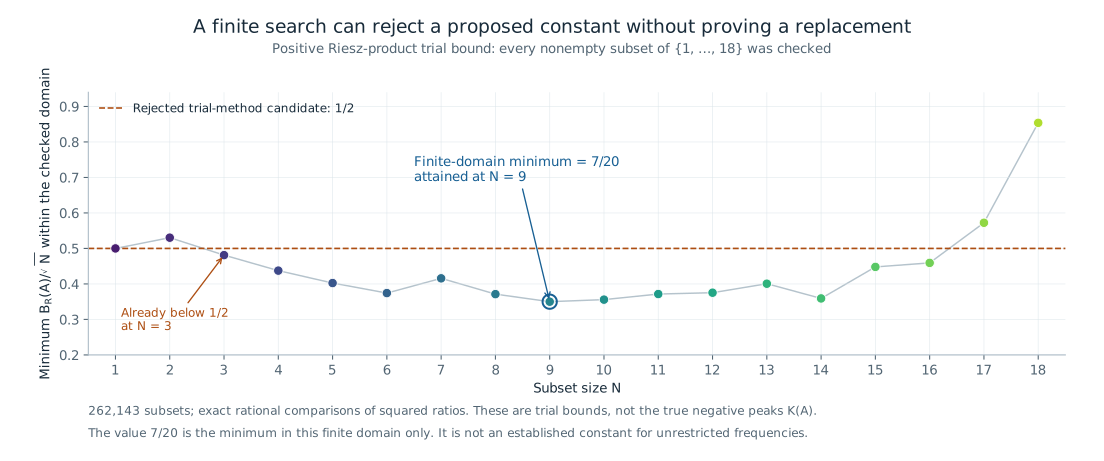 Figure data (JSON) · SVG · PNG
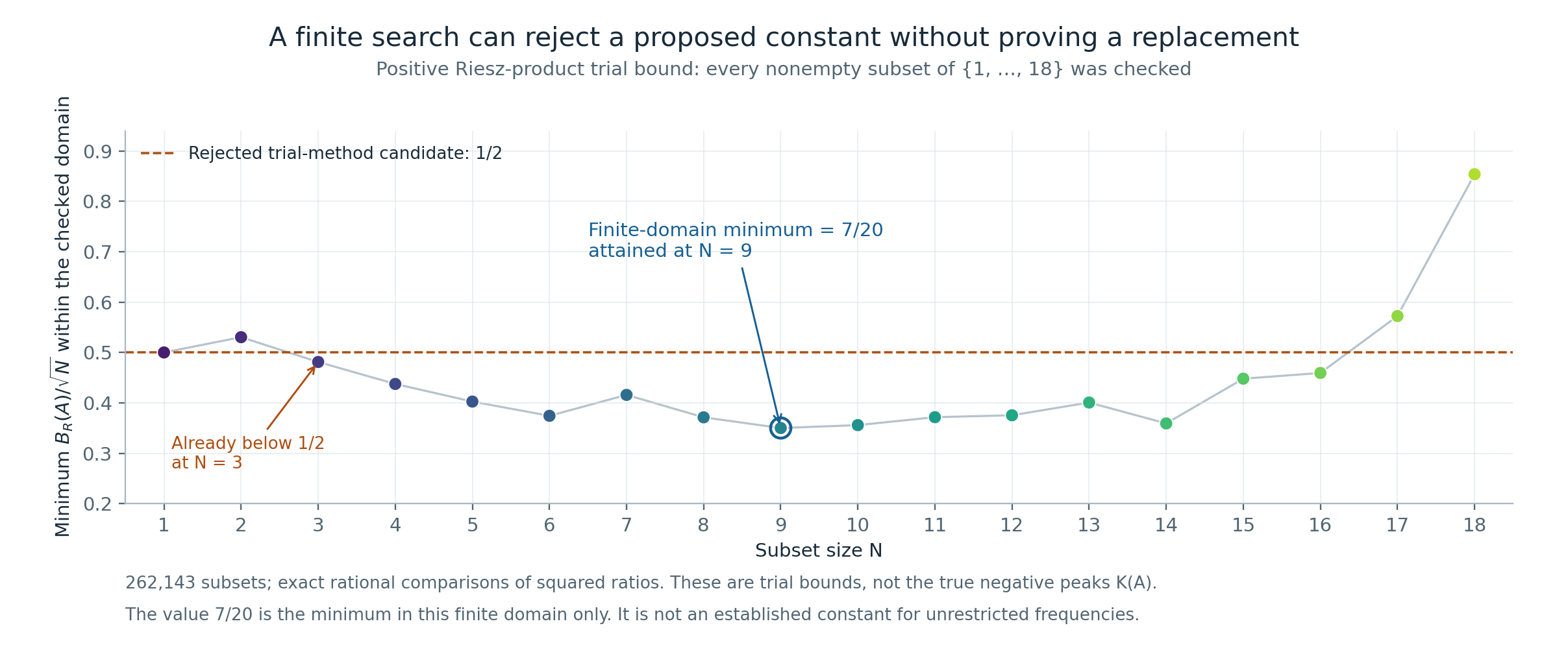
Exact rational comparisons over the 262,143 nonempty subsets of give the minimum normalized Riesz-product trial bound at each subset size. The proposed trial-method coefficient 1/2 already fails at . The smallest value in this finite domain is 7/20 at . These values concern a particular lower-bound method, not the actual negative depths, and do not establish 7/20 for unrestricted frequencies.
Explore interactively
88. Favor low values with Fermi–Dirac occupation
Outcome: valid weighting; zero-threshold detector uniformly too weak on intervals. The decreasing weight produces a nonnegative lower certificate after normalization. Its saturation, however, prevents it from concentrating arbitrarily strongly on rare deep events. For consecutive frequencies the record proves an upper bound for that certificate simultaneously for all nonnegative . Consequently no temperature choice rescues the specified zero-chemical-threshold detector at the square-root scale. Moving the threshold defines a different problem not settled by this argument. The Fermi–Dirac analogy does not change the original signal’s amplitudes or require an actual fermion system.
Source: Fermi–Dirac record.
89. Permit amplitudes to come in integer quanta
Outcome: broader weighted conjecture refuted by an infinite family. Equal amplitudes are stronger than merely integer amplitudes. The triangular weights give a scaled Fejér polynomial whose negative depth divided by tends to zero. The corresponding unscaled positive taper has constant negative depth. Thus amplitude quantization alone cannot replace the equal-unit-coefficient assumption. This is an exact counterexample to a weighted extension, not to Chowla’s original formulation. It also explains why an equalizer’s arbitrary gain settings cannot inherit a mathematical guarantee proved only for equal-amplitude modes without another transfer argument.
Source: amplitude-quantization record.
90. Quantize phase on a ring and then twist the boundary
Outcome: exact sampling counterexample and complete boundary-phase recovery. For , sampling at equally spaced phases gives depth exactly , while the continuous depth is at least . The grid retains the exact mean square and enough information for interpolation, but its smallest sample is not the continuous minimum. On a finite particle ring, these samples are eigenvalues under one boundary condition. Varying the boundary phase fills the continuous dispersion and recovers its minimum exactly. Quantization therefore requires boundary information; it does not supply an automatic universal constant.
Sources: phase-grid and boundary-twist record and separate internal audit.
What the catalogue establishes as a collection
The useful output is a set of explicit reductions, approximation guarantees, conditional certificates, and counterexamples to identified shortcuts. The strongest quantitative approximation result here is branch 83; it controls how accurately a moment hierarchy can approximate a minimum independently of the original maximum frequency. It does not control the minimum’s required growth with . The source comparisons in the main article determine how these observations relate to existing literature; a large catalogue by itself establishes neither novelty nor journal suitability.
The direct physical interpretation in branch 71, the lattice correspondence in branch 78, and the sampling example in branch 90 support accurate educational explanations. They do not demonstrate improved sound quality, a new acoustic effect, or a deployed product feature. The historical checks are valuable because their inputs, exact claims, limits, and occasional missing files are visible. A future extension should add a dated record and preserve this boundary between a proved special statement, a finite test, and a still-open universal claim.