
What can a collection of waves do together?
A sound wave is easy to draw. Its deepest possible trough can be surprisingly difficult to predict. Explore the role of frequency, shared phase, sampling, and mathematical proof through a research series developed alongside Bass Plus.
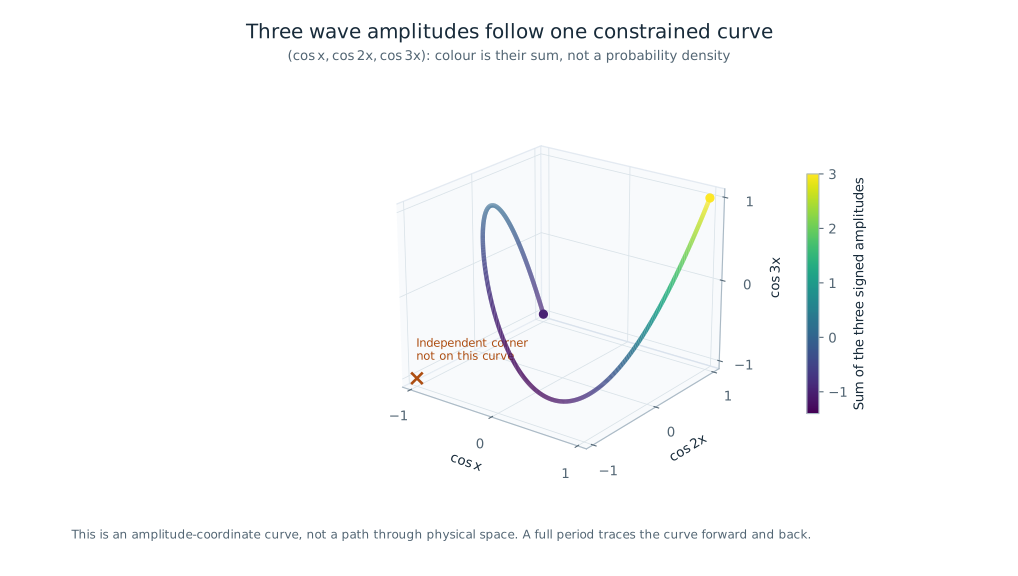
This collection combines explanatory articles, eight scientific figures, complete mathematical appendices, and a reproducible catalogue of ninety exploratory approaches. The central question is Chowla's cosine problem. The collection documents useful results and failed extensions; it does not claim a solution of that open problem.
Start with the research story
The Mathematics of Sound and the Search for Negative Peaks
The main illustrated report connects a simple synchronized-wave model to a universal mathematical question. It explains the strongest checked results, the physical meaning of the normalization, and the limits of the investigation.
Explore the ideas
A grid gets the RMS exactly right while missing a deep trough. See why reconstruction, plotting, and finding a certified minimum are different operations.
An exact Fourier translation turns a waveform into the spectrum of a hopping operator. A boundary phase reveals states that a finite ring initially misses.
Nonnegative polynomial weights provide controlled estimates of a minimum. Learn which part is established theory and what the explicit bound in this report guarantees.
Pressure, intensity, quantum occupation, and classical amplitudes are related concepts with different mathematical meanings. Exact counterexamples show where a proposed translation fails.
Inspect the research
Research Catalogue of Ninety Approaches
An indexed record of hypotheses, constructions, proofs, finite checks, and obstructions. Each entry links to the surviving evidence and states its scope.
Full derivations and proofs, with stable section anchors and explicit constants.
References and Literature Context
Primary mathematical and physical sources, including the established optimization methods used in this work.
Get the illustrated reading edition, the complete research edition, editable documents, source code, figure data, and historical research records.
About this collection
Research report · Version 1.0 · 18 October 2026 · Not peer reviewed
The ideal model has distinct positive integer frequencies, equal amplitudes, zero initial phases, and one shared clock. Its results help explain mathematical interference and measurement. They are not claims of measured performance or health benefits for Bass Plus. ChatGPT assisted the research and writing; verification details and provenance limitations are included with the full materials.