
The Limits of Wave Analogies
The research explored ideas from physics, biology, social dynamics, and optimization. Their usefulness depended on an exact question: which mathematical quantity survives the translation? An attractive analogy can generate a hypothesis, but its conclusion needs a proof in the original model.
Negative pressure is not negative energy
A cosine sum is signed. Its negative trough is the object of Chowla's problem. Acoustic pressure relative to equilibrium can also be negative, describing rarefaction. Average acoustic intensity, under the usual plane progressive-wave assumptions, depends on mean-square pressure and acoustic impedance. Squaring a waveform discards its sign, so an energy statement does not automatically constrain a negative pressure excursion. BakerAcoustics
A similar issue arises with a complex amplitude. Let . The sets and have exactly the same , because one complex sum is obtained from the other by a unit-modulus phase factor. Their real parts have different negative minima. This example concerns the squared magnitude of a complex amplitude; it does not assert equality of the squares of their real waveforms. That qualification prevents a misleading physical interpretation.
Equal energy does not fix a signed trough
For distinct unit-amplitude cosine frequencies, the full-period mean square is always . The two sets and therefore have the same RMS amplitude while their negative depths are and . Any proposed formula using only this energy statistic must miss information about arithmetic phase constraints.
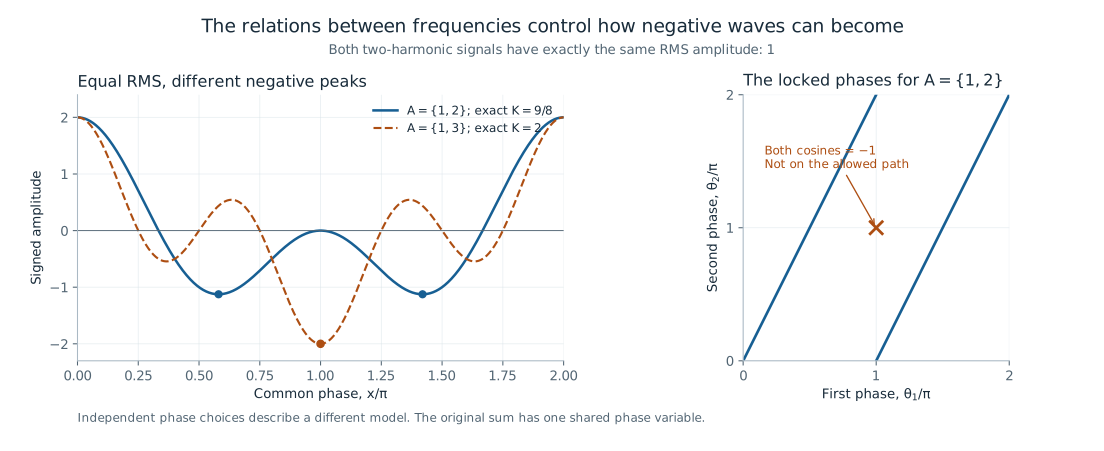 Figure data (JSON) · SVG · PNG
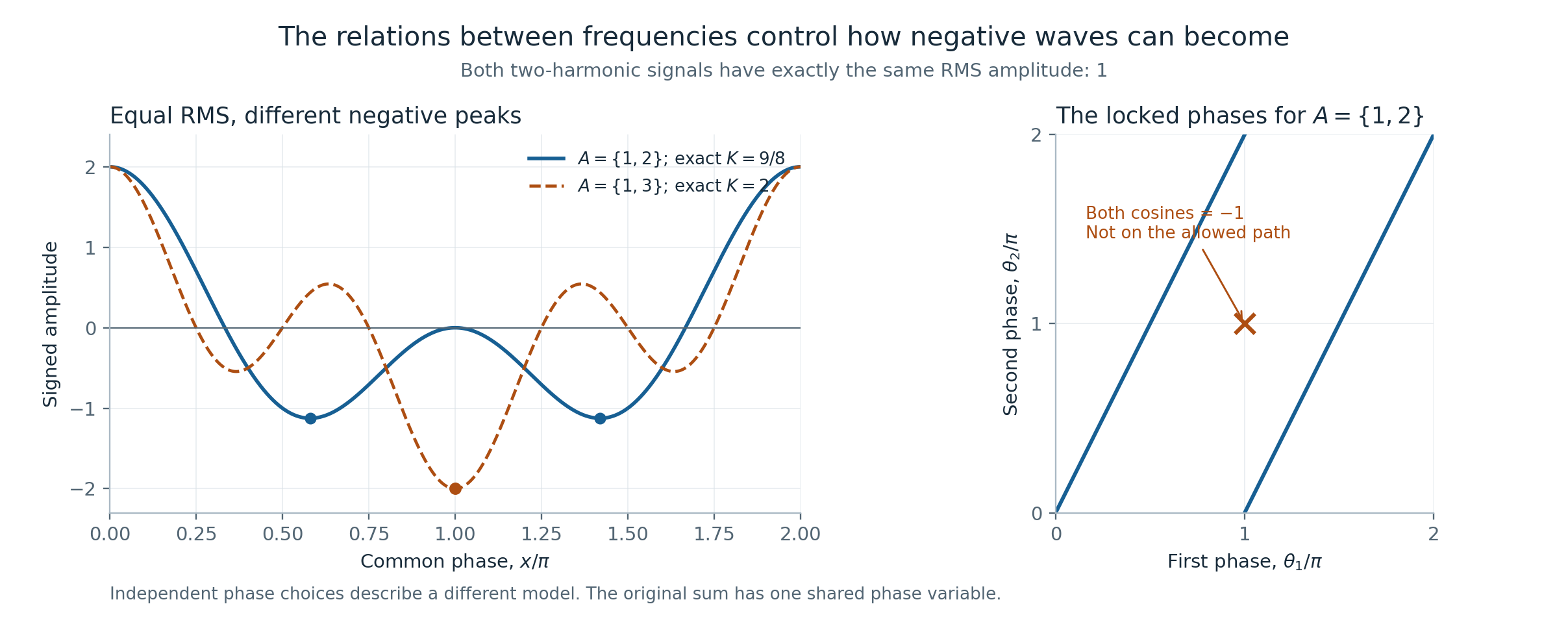
Figure. The comparison separates the average squared amplitude from the attainable negative peak. It also marks the independently adjustable phase value as belonging to a different model.
Integer amplitudes are not enough
The user-inspired question about quantization led to a precise test: would restricting coefficients to positive integers restore a square-root lower bound normalized by coefficient energy? The answer is no. Start with the Fejér weights . The nonnegative Fejér kernel gives a weighted negative depth of exactly . Scaling to integer weights gives
Consequently . This is a rigorous obstruction to the weighted extension. It leaves the original unit-amplitude problem untouched because the coefficients in that problem must all equal one.
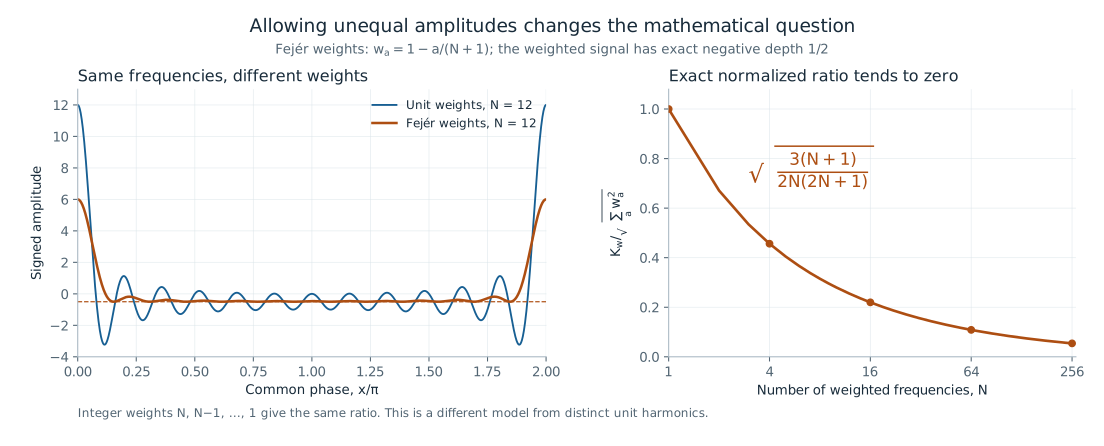 Figure data (JSON) · SVG · PNG
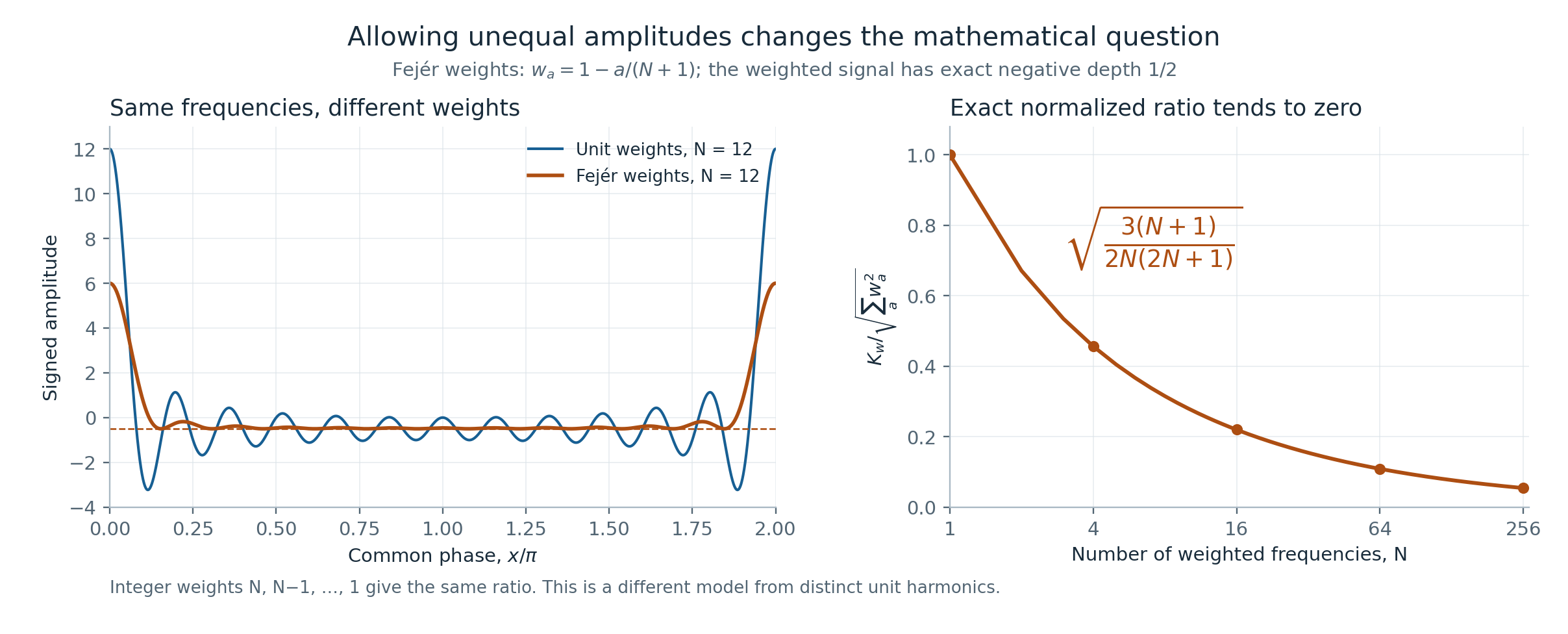
Figure. The pulse shape and the normalization curve explain the counterexample together. The tall positive pulse is compensated by a shallow negative floor over a broad region.
Explore interactively
What phonons actually quantize
For a harmonic oscillator, the number operator has integer eigenvalues and the energy levels are . That is a statement about measurement outcomes in a quantum model. In a number state, the mean displacement is zero. For a coherent state with complex parameter , the mean occupation is , which need not be an integer, while the mean displacement oscillates sinusoidally. A classical Fourier coefficient can be associated with a coherent mean without becoming an integer. Cappellaro2012 Shapiro6453
Squeezing further illustrates the distinction: it changes quadrature variances while a chosen displacement can preserve the mean waveform. A bound on fluctuations and a bound on the signed mean are different statements. Experiments that control a single mechanical quantum establish the physical relevance of phonons, but do not supply a theorem about every classical cosine sum. OConnell2010
The exact lattice operator in Waves and Lattice Particles is more productive for this particular problem because it preserves the minimum itself. Even there, the spectral correspondence does not prove the desired universal lower bound.
Biology and social dynamics as search tools
Ideas such as selection, competition, and consensus can suggest a nonnegative weighting scheme or an optimization process. Once translated, the method has to specify its objective, normalization, and domain. A replicator-like rule may concentrate weight on low values, but convergence to a minimum says nothing yet about how negative that minimum must be for every frequency set. A game may become easier when its adversary is restricted to a finite frequency range; that restricted value is not automatically the value of the unrestricted game.
The Research Catalogue of Ninety Approaches records these translations and their actual outcomes. Some produce exact identities, some give approximations or useful counterexamples, and some remain unproved hypotheses. Treating those statuses separately makes unusual approaches scientifically useful: it lets another reader reproduce the successful step, understand the failed implication, and formulate a different next test.